“Miss Sessions has a large nursery on the mesa. Perhaps she could help you.” “An excellent idea, Master Cong,” he said, turning back towards the hotel lobby. “We must go there immediately.”
Chapter 22, The Deadly Stingaree
Kate Sessions, San Francisco, 1857
If you were to visit San Diego in 1891, the year The Deadly Stingaree takes place, you would see few, if any, of the trees you find here today. Sagebrush and other scrubby plants covered the hills. There were no eucalyptus, pine, oak, cypress and pepper trees. The proliferation of those trees and many other plants is largely due to the work of one remarkable woman—Kate Sessions.
Sessions was born in San Francisco, California in 1857. She graduated from UC Berkeley in 1877 with a degree in natural science. In 1883 she moved to San Diego, where she worked as an eighth grade teacher and vice-principal at the Russ School.
Sessions was interested in more than teaching, though, and pursued her interest in plant cultivation after moving to San Diego. She leased 30 acres of land in what was then known as City Park in exchange for planting 100 trees in the park every year (as well as 300 trees annually in greater San Diego). City Park was renamed Balboa Park in 1910 and many of the large trees remaining today were planted by Sessions. She was named the “Mother of Balboa Park” at the California Pacific International Exposition in September, 1935. A statue of her was dedicated at the park’s entrance in 1998.
Statue of Kate Sessions at the Sixth Avenue entrance to Balboa Park
“If I am not mistaken,” he said. “This is the fruit of a Peruvian pepper tree.” “You are correct,” said Miss Sessions, inspecting the peppercorn. “I have a dozen of them on the grounds.”
Chapter 23, The Deadly stingaree
One of the trees Kate Session introduced to San Diego was the Peruvian Pepper tree. A single one of these trees may drop thousands of tiny red berries on the ground. Miss Sessions had only recently introduced the trees to San Diego when the events described in The Deadly Stingaree take place. Which is why the discovery of a single red peppercorn at the scene of a murder becomes an important clue to those investigating the crime. There were only a few places in San Diego where those trees could be found at the time.
“In all my travels, I have never seen a collection of flora to match the one you have collected here. I assume I am addressing its chief curator, Miss Sessions?”
Chapter 23, The Deadly stingaree
Sessions was the first woman awarded the Meyer Medal for “foreign plant importation” by the American Genetic Association. A Pacific Beach elementary school was named in her honor, as well as the Kate Sessions Memorial Park on Mount Soledad. The Women’s Museum of California inducted her into the San Diego County Women’s Hall of Fame in 2006.
The Mission Hills Nursery was founded by Sessions in 1910. She sold it to her employees, the Antonicelli brothers, in 1926. You can still purchase plants and gardening supplies at the nursery today.
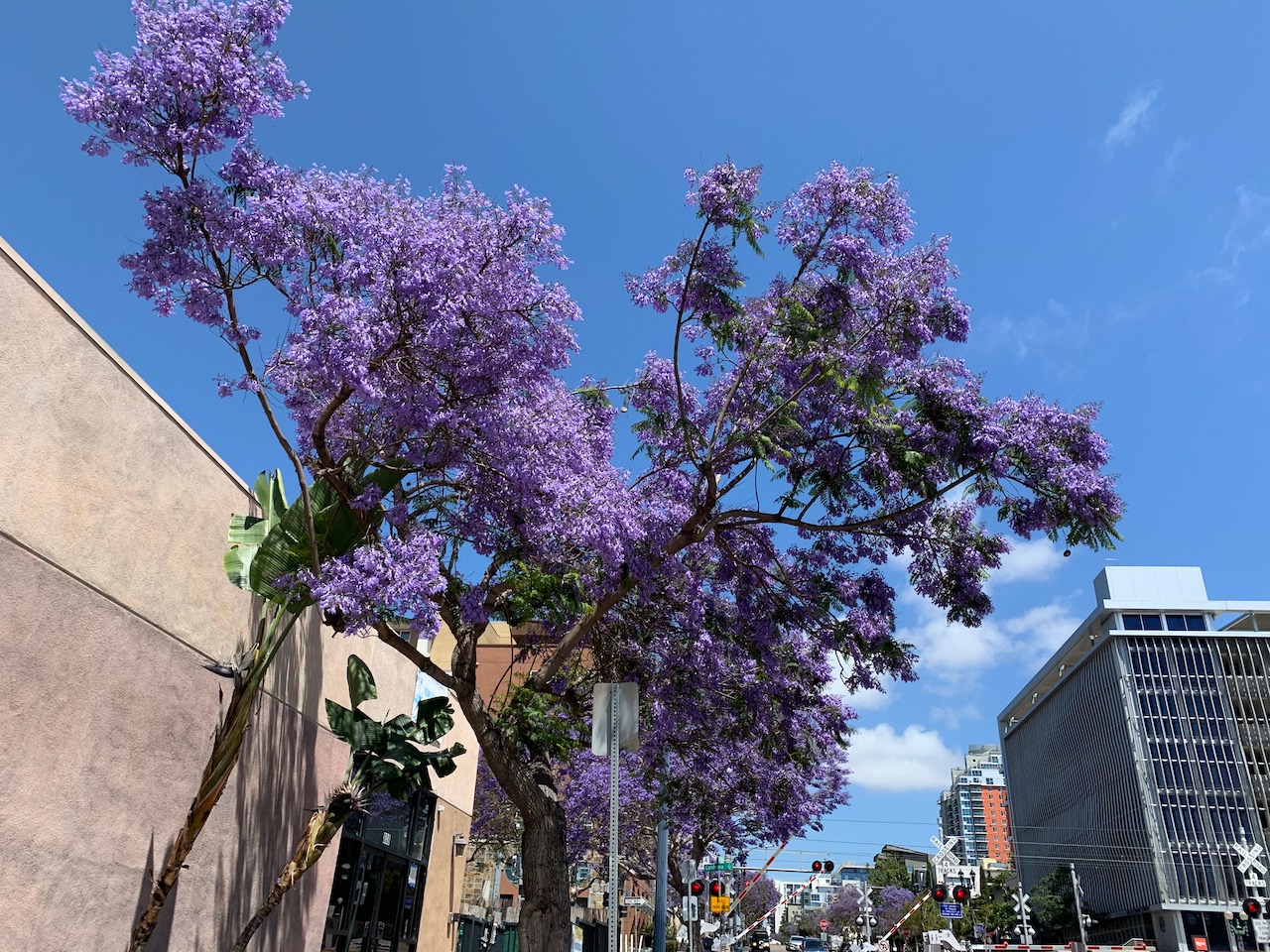
Kate Sessions was also the first to import and plant Jacaranda trees in San Diego. Their blooming purple petals has long been a treasured sign of Spring here in our city.




Leave a Reply